Safety equipment requirements for recreational boats in Poland are set by two main frameworks: the Inland Navigation Technical Regulations (for inland waterways, rivers, and lakes) and maritime regulations governing Baltic coastal passage. The applicable rules depend on the type of vessel, its length, and the waters being sailed. This guide outlines what is required, what is strongly recommended, and why each item matters.
This content is informational and does not substitute for a review of the current legal text. Regulations are updated periodically; always verify requirements with the relevant authority — the Office of Technical Inspection (Urząd Dozoru Technicznego, UDT) for inland craft, or the maritime administration for coastal sailing.
Life Jackets and Personal Flotation Devices
A certified lifejacket (or personal flotation device, PFD) for every person on board is the most fundamental safety requirement. Polish regulations distinguish between:
| Type | Buoyancy (Newtons) | Typical Application |
|---|---|---|
| Lifejacket Class 150 | 150 N | Open sea and rough coastal water — self-righting capability |
| Lifejacket Class 100 | 100 N | Inshore and sheltered coastal water — most common on keelboats |
| Buoyancy Aid (50 N) | 50 N | Dinghy sailing, kayaking — conscious wearer only |
Inflatable lifejackets must be serviced at intervals specified by the manufacturer — typically every one to three years — to ensure the inflation mechanism and gas cylinder remain functional. Many sailing clubs in Poland hold annual equipment checks before the season opens.
Children and Life Jackets
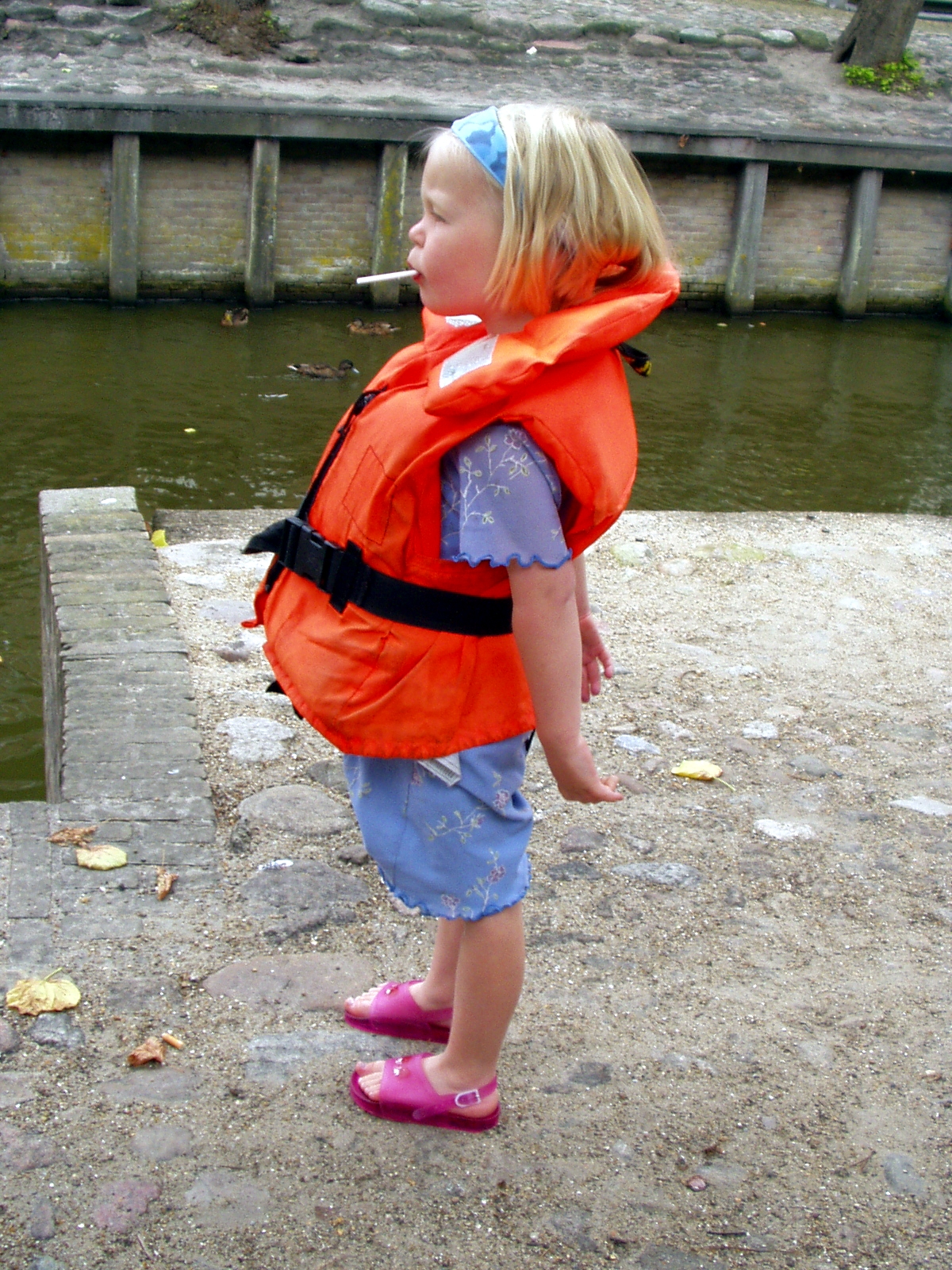
Lifejackets for children are sized by weight rather than age. A child's lifejacket must be specifically rated for the child's weight range — an adult lifejacket does not fit correctly and will not hold an unconscious child face-up in the water. Children should wear their lifejackets on deck whenever the boat is moving.
Throwing and Rescue Equipment
Lifebuoy (Horseshoe Buoy)
A lifebuoy is a ring or horseshoe-shaped flotation device kept at the stern and immediately deployable if a person goes overboard. Polish inland regulations require at least one lifebuoy per vessel over 5 metres. The horseshoe buoy is preferred over a ring because a person in the water can step into it without needing to lift it over their head.
Throwing Line
A throwing line (heaving line) is a lightweight rope that can be thrown to a person in the water from the boat. The bag-style throw bag, which contains the coiled rope and can be thrown accurately, is the most practical format for recreational use. A line of 15–25 metres covers most man-overboard scenarios on a keelboat in light conditions.
Man Overboard Equipment
Beyond the lifebuoy and throw line, a comprehensive man-overboard (MOB) setup typically includes:
- A danbuoy — a tall flagged spar that marks the position of the person in the water
- A GPS MOB marker button on the chartplotter (presses instantly to record position)
- A boarding ladder that can be deployed from the water — many boats cannot be reboarded without one

Fire Extinguishers
Fire on a boat is a rapid emergency — there is nowhere to escape to except the water. Fire extinguisher requirements vary by vessel type and whether the boat carries fuel or a galley with cooking gas.
Fire Extinguisher Guidelines for Recreational Vessels
- Sailing yachts with a petrol or diesel engine should carry at least one 2 kg dry powder or CO₂ extinguisher
- Boats with a below-decks galley are typically required to carry a second extinguisher near the companionway
- Extinguishers must be within their service date — check annually before the season
- Dry powder extinguishers are effective on engine and electrical fires; CO₂ is preferable near electronics as it leaves no residue
- For gas cooking: know where the shut-off valve is and ventilate the bilge before starting the engine
Visual Distress Signals
Visual distress signals allow a vessel in trouble to attract the attention of other craft or the coast guard. Requirements differ between inland and coastal sailing:
Inland Waters
On inland waterways and lakes, the primary distress signal is VHF radio (Channel 16 is the international distress frequency). Flares are not always required for inland waterway sailing but are advisable on larger, more exposed lakes such as Śniardwy where rescue response times may be longer.
Coastal Waters
For Baltic coastal passages, a flare kit is generally required. The standard kit includes:
- Red parachute flares (reach high altitude, visible for many kilometres)
- Red hand flares (for close-range signalling when rescue is near)
- Orange smoke signals (effective in daytime, attracts helicopter crew attention)
Flares have a limited shelf life — typically three years from manufacture — and expired flares must not be kept on board in place of valid ones. The disposal of expired pyrotechnics should be arranged through official channels; they cannot simply be discarded.
VHF Radio
A VHF marine radio is required on vessels operating in Polish maritime waters. For inland sailing, it is not always a legal requirement, but it is the primary means of calling for help on larger lakes and is standard equipment on most keelboats.
Channel 16 (156.800 MHz) is the international distress, urgency, and calling channel — monitored continuously by the Maritime Rescue Coordination Centre in Gdynia (MRCC Gdynia) and by the Polish Coast Guard. All vessels with VHF are expected to monitor Channel 16 when under way.
Operators of VHF marine radios in Poland require a Short Range Certificate (SRC) — a qualification covering basic radio procedures, distress calls, and GMDSS (Global Maritime Distress and Safety System) operations. The SRC is obtainable through the Polish Yachting Association.
First Aid Kit
A marine first aid kit should be appropriate for the number of people aboard and the distance from medical facilities. At minimum, a kit for day sailing on inland waters should include:
- Wound dressings and bandages in sterile packaging
- Adhesive plasters and butterfly strips for lacerations
- Antiseptic wipes and cream
- Seasickness medication (e.g. meclizine or dimenhydrinate) — relevant for Baltic coastal sailing
- Painkiller tablets
- Thermal (space) blanket — hypothermia is a risk even in summer if someone goes in the water
- Emergency contact numbers including MRCC Gdynia: +48 58 620 62 62
Anchor and Ground Tackle
An anchor is not always listed as a legal requirement for recreational day sailing, but it serves critical safety functions: it can stop a boat from drifting onto a lee shore if the engine fails, hold position while a problem is assessed, and serve as a last resort if conditions deteriorate. For Masurian lake sailing, a small danforth-type anchor on 30 metres of chain and warp is standard. For coastal passages, a heavier anchor rated for the boat's displacement is appropriate.
Navigation Lights
Any vessel that may be underway at night or in restricted visibility must carry navigation lights that meet COLREGS requirements:
- Port (red) and starboard (green) sidelights — visible from ahead to 112.5° each side
- Stern light (white) — visible from astern over a 135° arc
- Masthead light (white) — required when motoring, not when under sail alone
A sailing vessel may show an all-round red-over-green combination light at the masthead as an alternative to separate side and stern lights. Many modern sailing yachts use LED navigation lights for lower power consumption.
Equipment Maintenance Before the Season
Polish sailing clubs typically open the season between late April and May. Before each season, a systematic check of safety equipment is standard practice. Key checks:
Pre-Season Safety Check
- Inflate and inspect each lifejacket bladder; check inflation mechanism and hydrostatic pellet (if fitted)
- Inspect throwing lines for wear and repack bag-style throw ropes
- Check fire extinguisher pressure gauges and service dates
- Confirm flare expiry dates; arrange replacement if any have expired
- Test VHF radio on a working channel — do not test on Channel 16
- Check first aid kit contents and replace any expired medications or used items
- Inspect navigation lights and replace any failed bulbs or LEDs
Regulatory Reference
Current requirements for recreational inland vessels are set out in the Rozporządzenie w sprawie wymagań technicznych i wyposażenia jednostek pływających żeglugi śródlądowej — the inland waterway technical regulations. For coastal and maritime sailing, the applicable framework is based on maritime administration directives and EU Directive 2013/53/EU on recreational craft.
The Polish Yachting Association (PZŻ) provides guidance documents in Polish summarising equipment requirements for vessels seeking the annual technical inspection stamp.